Pete Hegseth Shocked by Report: High Number of Overweight Troops Threatens "Fitness Not Fat" Ideal

Pete Hegseth referred to a report stating that two-thirds of reserve troops being overweight was deemed 'unacceptable' and pledged to implement changes to ensure they become 'fit not fat.'
The American Security Project stated that 68 percent of America's reserves are not fit for duty and called for new policies to address this problem, warning that it might lead to issues if these forces were deployed.
'With the diminished size of the [active-duty] force and increasing demands on the National Guard and reserves, service members separated due to obesity and its comorbidities are vital personnel the Armed Forces cannot afford to lose,' the report states.
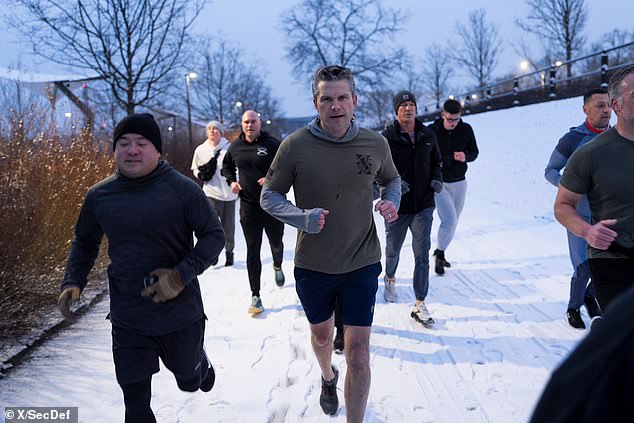
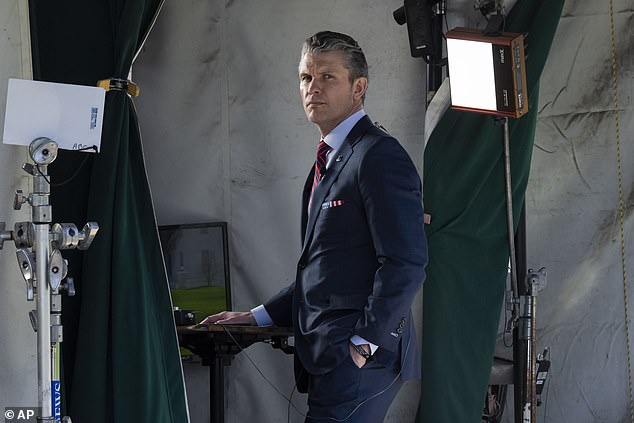
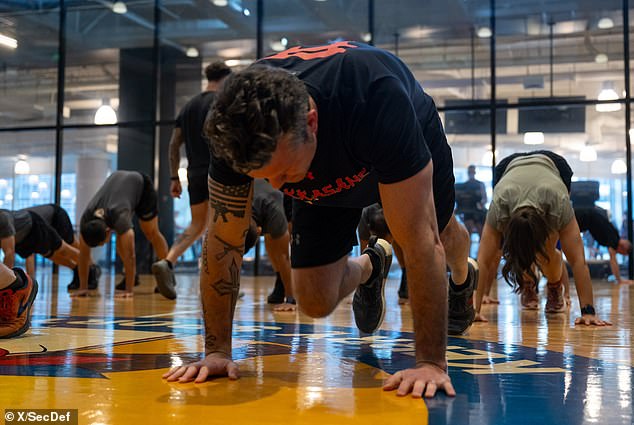
Defense Secretary Hegseth — known for frequently sharing videos and images of himself training alongside service members — expressed his anger over the figures in a social media update.
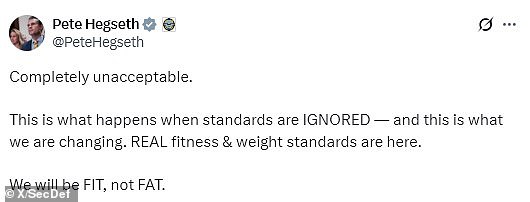
'This is entirely unacceptable. When standards are ignored, this is the result — but change is coming now. Genuine fitness and weight criteria are being implemented. We aim to be fit, not fat,' he stated.
Perhaps even more startlingly, ASP has stated that comparable rates of obesity are present within the active-duty forces.
"Even though the issues related to obesity within the reserve component mirror those faced by the active component, commanders and policymakers won’t be able to address these trends using a one-size-fits-all strategy," they noted.
The 68 percent figure represents a decline from the previously elevated 65 percent level of overweight reserves observed in 2018.
According to the report, these service members face an increased danger from numerous severe health issues like type 2 diabetes, cardiovascular diseases, chronic kidney disorders, and osteoarthritis, potentially resulting in critical health crises including strokes and heart failures.
The researchers utilize the BMI scale, which certain individuals label as imprecise due to its failure to consider muscle mass.
They suggest addressing the problem through additional research and monitoring, expanding healthcare coverage for reservists, and enhancing the maintenance of military health records.
It reflects Hegseth's address to the Army War College last Wednesday.
"To become the globe’s premier and most efficient combat unit, we must establish and sustain stringent benchmarks for our service members," he stated.
' To be deadly, you must rely on the warrior next to you. The battles or the fights involving the troops within the units that many of you will command are indeed physically capable of performing what is required when under attack.
He stated, "It’s crucial that they are fit rather than overweight and sharp instead of rundown—especially for our leaders. This is precisely why we’re reassessing how the division has upheld its standards over recent times, particularly focusing on the previous four years, and determining if these benchmarks have declined either officially or unofficially."
Earlier this month, Hegseth directed the military to establish fitness criteria for every combat role. gender not favorably received, as it has upset numerous women who view the decision as unjust.
In a recent memorandum, the defense secretary instructed military service leaders to differentiate between roles classified as combat arms—such as those in special operations or infantry—that necessitate "increased initial and ongoing physical conditioning," from others that do not have these requirements.
The memorandum issued on Monday stated that all physical fitness criteria for these combat roles should be free from gender bias, "determined exclusively by the functional needs of the job and the preparedness required to face any opponent."
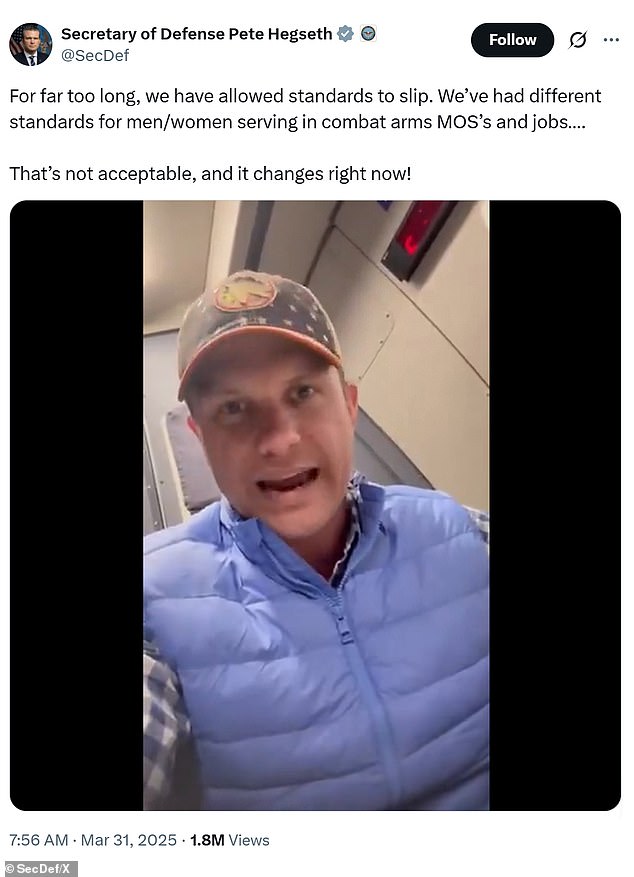
Hegseth presented the updated guidelines in an X post, stating: "For far too long, we have tolerated declining standards. There have been varying criteria for men and women serving in combat arms Military Occupational Specialties and roles... This is unacceptable, and those discrepancies will be rectified immediately!"
The updated directive builds upon a memorandum issued by Hegseth on March 12, stating that the undersecretary for personnel should collect data regarding military guidelines related to 'physical fitness, body composition, as well as grooming norms that encompass facial hair among other aspects.'
Both reflect Hegseth's public complaints about fitness standards well before he took on the Pentagon job.
While working as a Fox News The commentator, Hegseth, discussed his stance against assigning women to combat roles and his view that the established criteria were relaxed to make way for female service members.
Hegseth’s objection – as expressed in his writings and discussions – was straightforward prior to his nomination on November 12. However, when questioned by Congress, he seems to have changed his position.
"I am simply stating that including women in combat positions has not enhanced our effectiveness or increased our lethality. Instead, it has only added complexity to warfare," he stated during a November 7th podcast with Shawn Ryan.
He stated that women should be included in the military but not in roles related to special operations, artillery, infantry, and armored units.
The armed forces have traditionally maintained a predominantly dual-component framework for their physical fitness criteria.
The first involves regular yearly health assessments with varying criteria determined by sex and age.
The other involves stricter criteria for particular combat roles, such as special operations, infantry, armored units, pararescue jumpers, and similar positions that apply uniformly across all individuals within those professions, without adjustments based on age or gender.
It seems that Hegseth's memorandum primarily addresses the second category, making the case for stricter physical fitness requirements for roles involving combat duties.
Currently, certain military roles such as those in special operations, infantry, armor, and pararescue necessitate distinct, advanced physical — along with frequently more rigorous mental and psychological — assessments, criteria, and qualifying programs.
Those standards require everyone to meet the same requirements, regardless of their age or gender.
For instance, an army service member aiming to become a Green Beret or a Ranger, as well as a sailor aspiring to join the ranks of the Navy SEALs, needs to successfully complete rigorous multi-month qualifying programs.
Additionally, once the Pentagon permitted women to take on all combat roles, the Army established uniform physical fitness criteria for every military position, applicable irrespective of age or gender.
Trainees aspiring to join an infantry or armor role have to meet stringent requirements through a specialized physical evaluation before they can commit to such a position via their contractual agreement.
Likewise, the Marine Corps has higher fitness requirements for their special operations personnel and those in combat roles.
Hegseth's memorandum refers to increased physical fitness standards for special operations units—standards that are already in place.
It states that Navy divers and explosives ordnance disposal experts should also be mandated to possess expertise in activities like water rescue and demolition, which are part of their current responsibilities.
The directive grants service heads 60 days to submit suggested modifications. Within 30 days after that, they must deliver an initial progress report.
"As warfare continues to evolve and the requirements for our service members become increasingly intricate, it is crucial that we evaluate and improve upon the physical fitness standards which support our preparedness and combat effectiveness," Hegseth stated in the memorandum.
Read more