Scientists Unveil the Secret to Perfect Boiled Eggs

- EXPLORE MORE: Unusual and delightful methods folks use to spice up their cuppa-tea
It is among the simplest tasks you can perform in the kitchen.
However, it seems you have likely been boiling your eggs incorrectly all along.
Researchers have discovered the optimal method for boiling an egg uniformly, ensuring the yolk turns out perfectly smooth and creamy while the egg whites remain firm and not runny.
For those accustomed to enjoying a mild, six-minute soft-boiled egg, the sole drawback is that this alternative approach requires more than 30 minutes.
Material engineers in Italy went through 300 eggs attempting to discover the perfect method for boiling one with optimal texture, flavor, and nutritional value.
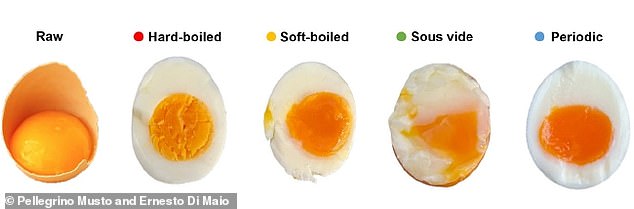
They were contrasting a hard-boiled egg, a soft-boiled egg, the 'sous vide' method favored by upscale eateries, along with an entirely new approach.
This method involves alternately submerging an egg eight times between a pot of boiling water and a bowl of cold water, resulting in perfection as per the professionals.
This solves the issue of having a yolky center that’s just right while the egg whites remain uncooked, which typically occurs with eggs boiled inside their shells.
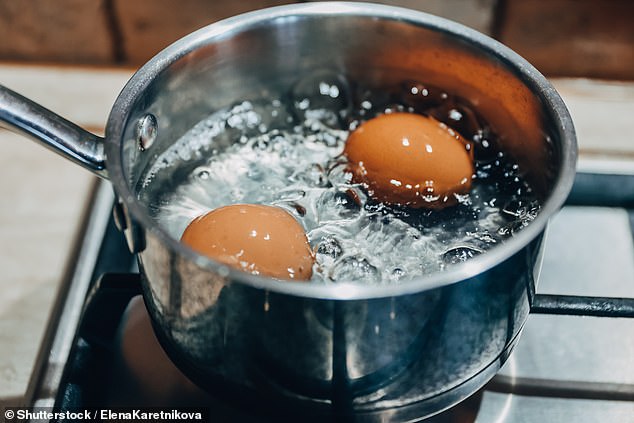
Scientists succeeded in heating the egg whites to an ideal temperature of 85°C, and the yolks to nearly the perfect temperature of 65°C.
The trick lies in continuously taking the egg out of the boiling water and submerging it in cold water, preventing the yolk from turning hard and firm, while ensuring the egg whites slowly cook just enough to provide some texture.
Professor Ernesto Di Maio, the lead researcher from the University of Naples Federico II who typically focuses on plastics, developed the 'periodic cooking' method and prepared all 300 eggs in his own kitchen at home.
He stated: "I believed that the methods employed in materials science could create the ideal egg, and indeed, the outcome turned out to be exquisite."
I've convinced 50 members of my family and circle of friends to enjoy eggs prepared this method, which we garnished with lemon and pepper at our lab's Christmas celebration.
It could take about 32 minutes to prepare this specific type of egg, and I realize that many individuals might not have the time available; however, I believe it’s worthwhile doing so for those dear to us instead of serving them improperly cooked eggs.
The research aimed to enhance 'sous vide' eggs, which are cooked for a minimum of one hour at consistently low temperatures, usually ranging from 60°C to 70°C, resulting in yolks with a smooth consistency.
According to Professor Di Maio, the problem lies in the fact that the egg whites are undercooked, appearing translucent and remaining too liquid.
The team he was leading included a researcher who later revealed his dislike for eggs. They utilized advanced mathematical modeling techniques to determine the optimal method of cooking eggs.
They subsequently put these methods to the test, employing three different approaches involving shining light beams onto eggs to assess both their level of cooking and nutritional content.
In the meantime, eight skilled tasters evaluated hard-boiled, soft-boiled, sous-vide, and intermittently cooked eggs, assessing their characteristics such as color, meltable quality, and degree of softness.
The findings, as reported in the journal Communications Engineering, revealed that eggs prepared with the periodic method exhibited a sweeter and saltier yolk compared to those that were softly boiled.
The consistency of the yolk closely resembled that of a sous vide egg, yet the egg whites were softer, more moist, and translucent.
Its texture was midway between a sous vide egg and a softly boiled one.
Professor Di Maio stated: "This egg spreads more easily on toast compared to a sous vide egg, which tends to soak into the bread."
However, it is still not appropriate to place it in an eggcup and eat it with toast soldiers, as this would necessitate a softly boiled egg.
The novel method proved superior in enhancing egg nutrition compared to the other three techniques, though researchers indicate that additional studies are necessary to comprehend why this is the case.
The temperatures in the partially cooked egg whites fluctuated between 35°C and 100°C throughout the cooking process, whereas the yolks reached and maintained a temperature of 67°C.
Read more